Showing posts with label area model. Show all posts

Saturday, March 3, 2018

Week 26: March 5 - 9

Week 26: March 5 - 9

Reminders:
9 - Report Cards go home
12-16 Spring Break (No School)
20 - Third Nine Weeks Recognition Ceremony at 9:00 in the cafeteria
23 - Solar System Test
30 - Good Friday (No School)

Reading: Our students worked hard last week and showed amazing effort and skill on the READING practice STAAR test.  Please look for an email from your child's reading teacher by Friday, March 9th to tell you more about your child's reading strengths and areas for growth.  Mostly, know we are PROUD of their reading accomplishments thus far and it is only MARCH!


Narrative NonFiction will continue to be our genre focus for this week. Above you can see some of the titles we have been reading and discussing in class.  Specifically, this week, we will teach students a silly song that can serve as an EXCELLENT strategy for writing summaries or answering STAAR like questions about summary with narrative.  For a sneak peak, or simply to keep the fun going at home, check out this clip.


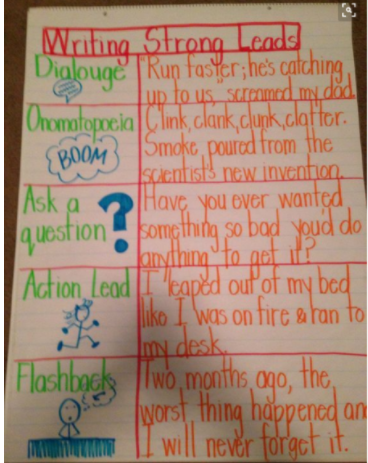
Writing: Essays will continue to be our genre of focus.  This week we will look at how to write a strong lead.  We will look at many styles and try them out with our first drafts to see which style might be most effective.  Below is a sample anchor chart.  Something like this will be built together in our classroom this week as we write.

Social Studies: Students will finish up their work with map skills.  We hope that maybe a few students have gotten excited and talked to you about how we learned to play BATTLESHIP using our grid map skills.  This week, we will also look the cultural traditions associated with St. Patrick's Day.

Math: During our math block this week, we will continue to look at division strategies and how we can apply these strategies to word problems. Your child will work to create division word problems to help with their understanding of the parts of  division word problems. On Wednesday and Friday, we will learn about area (Area Video). We have taught area models during our multiplication unit and we will make the connection between area and the area models we have already studied. On Thursday, we plan to complete a reflection paper from the practice STAAR that was taken last Monday. This tool helps your child zone in on the concepts they really understand and helps us to identify areas of need. We will send this paper home with your child so that you can use this as a discussion tool at home.


For homework this week, we will have a worksheet come home on Monday - Wednesday. We will not have a problem of the week this week. We will take a fast facts quiz on Friday. If you plan to be out of school on Friday, please let your child's teacher know so that they can take their fast facts quiz before the break.

Science: This week during science, we will continue talking about the relationship between the sun, moon, and Earth and our other planets. On Monday, we will work on the next set of vocabulary cards for the solar system unit. We will send home these cards and review sheet so that your child will be able to study nightly for our test. The date of the test Friday, March 23rd.  During the rest of the week, we will be studying the planets.


Sunday, January 28, 2018

Week 21: January 29th-February 2nd

Week 21:  January 29th-February 2nd

Reminders: 
2/2: Spring Group Pictures are this Friday.  These pictures are taken as homerooms.   Time slots are as follows. 10:25 Rozzell/Morphey, 10:35  Badrak/Saint Val, and 10:45 Duncan/Ford.  
2/6 and 2/7:  HCE Book Fair located in library. 
2/8 and 2/9: Noon Dismissal

Reading:  Determining the main idea of a text can be tricky business!  We're going to continue searching for text clues (text evidence) to infer the main idea of an entire or portion of text.  Your readers will see this week that identifying the main idea from several sections of an article will lead to a strong nonfiction summary.  We will conclude the week by introducing cause and effect relationships.  Cause and effect is something we experience in our daily lives.  We will learn tools to identify this relationship within a nonfiction text. 
Image result for cause and effect anchor chart
Writing:  We will celebrate your poet's hard work this week!  Our publishing celebrations are always a wonderful way to unite as a community of writers and "high five" one another on a job well done.  Your children are excited to share their finished anthologies with their peers.  Later in the week we will practice note taking strategies as we read through a nonfiction text and organize our thoughts/reactions and important ideas.  
Social Studies:  We're rounding out our study of maps this week.  Students will apply what they have learned throughout the month to create their own maps.  We're challenging them to include a title, compass rose, legend, map scale, and grid system.  
Math: We will continue to learn many strategies to multiply such as skip counting, number line, area model, and an array model. We will build from easier digits such as 5 and continue to increase the digit to 6 through 9. As it is important to know multiplication facts, we are helping our mathematicians understand and internalize what it truly means to multiply, where they can see it in the real world, and how to apply it in their daily lives. 


Homework: In addition to our Monday-Wednesday regular homework pages, we will begin "Problem of the Week." This assignment will be sent home every Monday and will need to be returned on Friday. This assignment is meant to be a team effort as we would like your student to solve the problem alongside you.  On Friday, we will discuss the many ways your student solved the problem with the support from you all! 
Science: The students will learn and understand how soil is formed and the role of decomposition. Later in the week, the students will explore plate tectonics and its relation to earthquakes and volcanoes. Soil is different in different places because of different rocks in the area and different plants and animals that live there and die and decay. Important concepts to remember:
  • Constructive forces build up the Earth
  • Destructive forces tear down the Earth
  • Earthquake:  A sudden release of energy under the Earth’s surface that makes the ground shake or crack.
  • Earthquakes build up the land (constructive) by pushing upward forming mountains and tear down the Earth (destructive) by opening crevices and causing land to fall or slide.
  • Weathering: The process that breaks down rocks into tiny pieces over time.
  • Erosion:  The carrying away of weathered rock 
 
  • Different types of Soil: Sand, Clay, Humus, Loam