Showing posts with label compare fractions. Show all posts

Sunday, April 8, 2018

Week 30: April 9-13

Reminders:

4/10 - Field Trip to River Oaks Country Club for Men's Clay Court Tennis Championship
4/18 - Field Trip to Main Street Theater
4/27 - Progress Reports go Home
5/9 - Bike to School Day
5/10 - Gallery Night @ 5:00
5/14 - Math STAAR
5/15 - Reading STAAR
5/22 - Publishers' Picnic
5/24 - Chariot Races @ 8:30
5/25 - Winds of Time Parade
5/28 - Memorial Day (No School)

ROCC Field Trip Information                                           Dress: Please try to send your child in this year’s gray #COUGARSTRONG t-shirt. Being dressed the same helps us better keep an eye on everyone. The weather is forecasted to be 60’s in the morning to mid 70’s by afternoon. A light jacket or sweater that can be tied around your child’s waist is appropriate.
   Lunch: We are eating an early lunch (10:00) at school in the cafeteria. Regular cafeteria food will be served. The menu for Tuesday is chicken and waffles, baked potato with cheese, salad with chicken, and Wowbutter and jelly sandwich. We will eat lunch as usual, just early.
   Snack: Everyone will be hungry when we return to school. Please be sure to send a good size, healthy snack your child can eat around 2 in the afternoon.
   Schedule: We eat lunch at 10-10:30, bathrooms and then board buses to leave at 10:45, arrive at ROCC at 11:15, restroom and then must be seated by 11:45, match is noon to 1:30, board buses and head to HCE at 1:30 to be home by 2:00 or so.
   Chaperones: Please arrive at school while we are at lunch (10-10:30) so you can help as we get ready to leave.

Math:
As we have concentrated on fractions on a number line, it is time to compare fractions in different forms. We will spend this week looking at fractions using fraction bars and circles to compare the amount of each shape that is shaded. The fraction with the larger area shaded is the greater fraction. When looking at the fractions in number form, the rules are simple. Just ask, "How big are the pieces?" When fractions have the same denominator (pieces of equal size), the numerator determines the comparison. The smaller numerator is the smaller fraction. When the numerators are the same and the denominators are different, the denominators determine the size. Larger denominators are smaller pieces and therefore the smaller fraction. 
Image result for comparing fractions anchor chart

Later in the week we will review all we have learned about fractions in a round robin activity. On Friday, we will complete a benchmark of past skills to see how we stand after our weeks of practice. Also on Friday we will have our usual Fast Fact Friday quiz and will check the Problem of the Week.

Science:
During the week we are logging the weather conditions in 10 different U.S. cities. This includes temperature, general sky conditions, humidity and wind. We are researching nine weather tools that help us forecast our own weather on a daily basis and long term. Vocabulary cards will go home this week that explain those tools. Students will be tested on them next week. Specific date to be determined. At the end of the week, we will review metric liquid volume. Students will participate in a very wet volume lab on Friday and have an opportunity to use various tools including beakers and graduated cylinders.
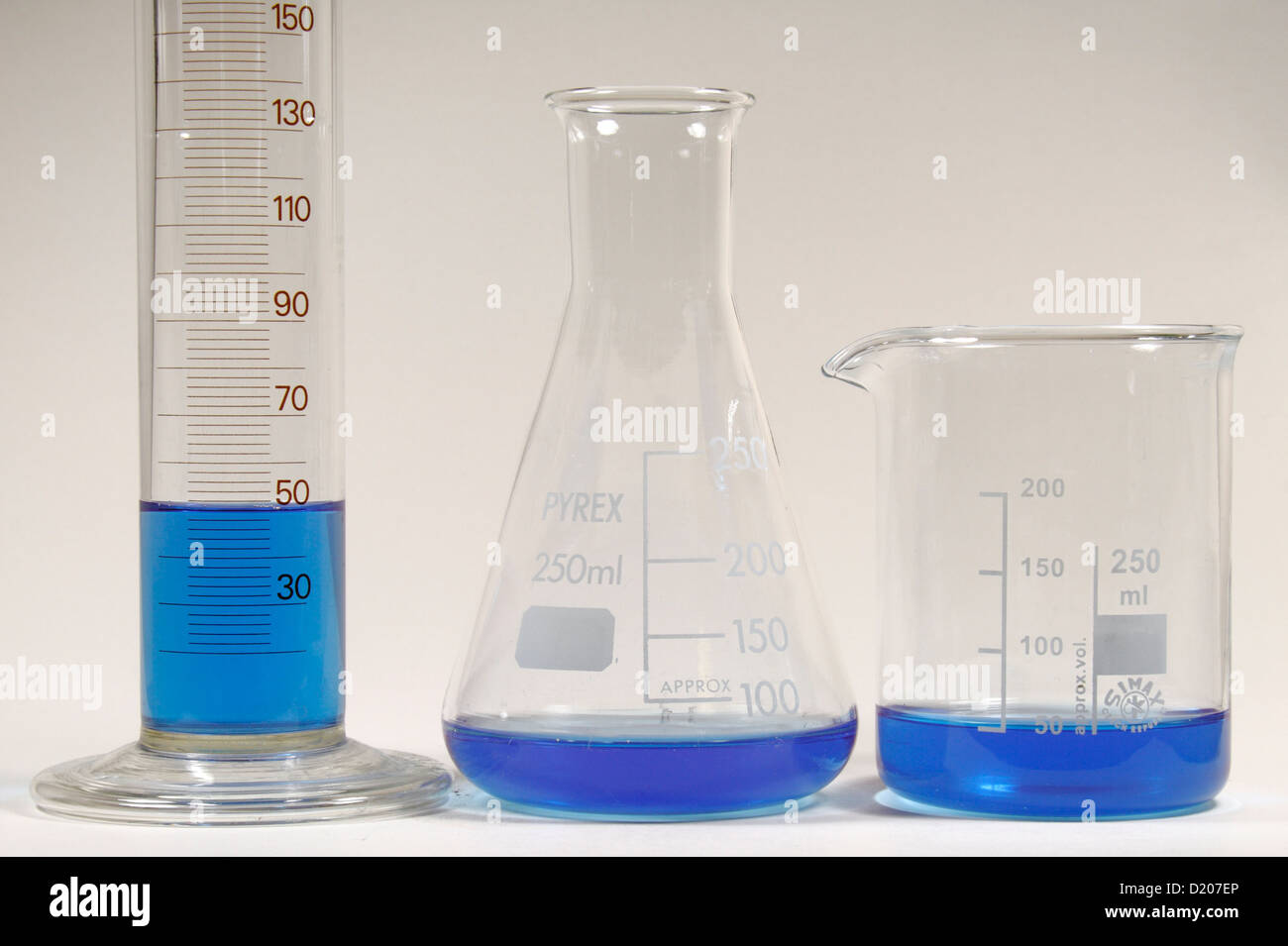
Image result for graduated cylinders and beakers
Reading:
All of our third grade students are participating in a grade level read aloud and discussion using the book Wishtree by Katherine Applegate. It was chosen in part for its eloquent vocabulary and in addition, for its powerful themes, including prejudice, friendship, kindness, and acceptance. Please ask your child to share about the book, and his/her reactions to the characters and plot.


Most of our time in reading is being spent working in small groups, with each student focusing on a genre that is tailored to their greatest area of need. The three types of text include: expository (informational text), literary nonfiction, (nonfiction content shared in story form-biographies are an example), and fiction. It is our goal to challenge our third graders not only to comprehend these texts, but to think on a much more in-depth level. For example, What was the author's purpose for writing this piece? What in the text lead you to that conclusion? How do the subtitles throughout the text connect? What is evidence of this? At the end of the week students will be taking an assessment about the genre they have been studying.

Writing: Our students continue through the writing process, revising and editing their piece of expository text. There is a saying: "When your draft is done, you've only just begun!" This idea of revising or making changes to improve the draft's content can be daunting for our budding writers, however we are teaching and modeling specific examples of how to revise effectively. For example, deleting words and phrases not needed, changing a single word to be more interesting or specific, or changing the punctuation in some way. This is a great opportunity for students to conference with not only their teachers, but with their peers.

Social Studies: Third grade Cougars are fine tuning their note taking skills as they continue their study of economics using the Econ and Me video series. Even though the videos date back to the 80s, (just looking at the hair makes that evident) their appeal is great, and the information still rings true today.  Students are learning about the importance of making smart economic choices, and understanding the benefits versus risks of each decision.

Monday, April 2, 2018

Week 29: April 2-6

Reminders:

4/10 - Field Trip to River Oaks Country Club for Men's Clay Court Tennis Championship
4/18 - Field Trip to Main Street Theater
4/27 - Progress Reports go Home
5/9 - Bike to School Day
5/10 - Gallery Night @ 5:00
5/14 - Math STAAR
5/15 - Reading STAAR
5/22 - Publishers' Picnic
5/24 - Chariot Races @ 8:30
5/25 - Winds of Time Parade
5/28 - Memorial Day (No School)


Math: As we better understand how to compare fractions with like denominators on a number line, we move on to comparing fractions with the same numerator but different denominators. The key is to visualize how big the pieces are. A very difficult concept for many students is that, as the denominator gets larger, the number of pieces the whole is divided into increases AND the size of the pieces gets smaller. The bigger the denominator, the smaller the pieces. So, 3/5 is smaller than 3/4 because the "fifths" pieces are smaller than the "fourths" pieces.
Image result for comparing fractions with unlike denominators

Related image
4/5 > 4/10

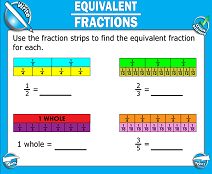
Later in the week we will begin a study of equivalent (equal) fractions or fractions that show the same amount but use different numerators and denominators. We will use various models and manipulatives to visualize the area covered by equivalent fractions.  
Image result for cuisenaire rods equivalent fractions
Students will construct a Fraction Taco and practice exchanging one fraction for its equivalent while playing this very fun game. 
We will also learn the box method of multiplying 2 digit X 1 digit. It is similar to the expanded form we learned last week but is put in a neat little box. Finally we move to the usual algorithm that most adults use.
Our usual Problem of the Week and Fast Fact Friday quiz will take place on Friday, April 6.

Science: This week students will complete an activity researching the current temperatures in 4 cities in different parts of the U.S. and world and record those temperatures on thermometers with different scales. Tuesday students are introduced to an on-going weather unit and will examine tools used by meteorologists to view current weather conditions and the movement of weather patterns across our area, state and country. 
Image result for weather map

Reading: Our readers will be working on how to approach a piece of text to determine which parts  are important vs. interesting. (Oftentimes these are two different things.)  The first step is to preview a piece of text to develop initial understanding. Secondly, the text is read and read again, this time considering what the writer would most want the reader to know. In addition, our children will continue their work evaluating the genre of test, and how it is uniquely different from other genres. For example, if you were reading a book for pleasure, it would not be typical to take notes, highlight key sections, or navigate how to best answer created questions. This is necessary when working through our state assessment.

Writing: Expository writing shouldn't sound robotic or leave the reader feeling bored!! This week HCE writers will work on developing effective endings. They have experimented with creating leads that draw a reader in, so now they will work on leaving the reader with "food for thought". Although the purpose of an ending is to restate the topic, it should be memorable and not repetitious. The models the teachers provide will give valuable insight to this craft.

Social Studies: Our global economy is complex, so it is never too soon to learn about how economies operate and the key concepts involved. This work our third graders will be using a video series called Econ and Me to understand about saving vs. spending, needs vs. wants, as well as how goods and services as well as producers and consumers are central to an economy. Who knows? By the end of study, we might just have the next child entrepreneur in our midst!

Monday, March 26, 2018

Week 28: March 26th - 30th

Week 28: March 26th - 30th

Reminders:
3/30 - Good Friday (No School)
4/10 - Field Trip to River Oaks Country Club for Men's Clay Court Tennis Championship
4/18 - Field Trip to Main Street Theater
4/27 - Progress Reports go Home
5/9 - Bike to School Day
5/10 - Gallery Night @ 5:00
5/14 - Math STAAR
5/15 - Reading STAAR
5/22 - Publishers' Picnic
5/24 - Chariot Races @ 8:30
5/25 - Winds of Time Parade
5/28 - Memorial Day (No School)


Math: During math this week, we will continue in our fractions unit. On Monday, we will use cuisenaire rods to identify and compare fractions. 


On Tuesday, Wednesday, and Thursday, we will learn to use a place a fraction on a number line and then use the number line to compare fractions. Reference the video to understand how we will be teaching this concept to your child: Video for Fractions on a Number Line. Due to our shortened week, we will only have a worksheet on Monday and Tuesday night. The fast facts quiz will be moved to Thursday.

Science: This week during science, we will learn how to read a thermometer to measure temperature. We will practice reading thermometers using scales of 1, 2, 5, and 10. These are the most common scales for a thermometer. On Wednesday, we will begin using technology to research temperatures of cities in different regions of the United States to understand the variety of seasons and temperatures we have in the US. By the end of the week, your child should understand how to identify the scale of a thermometer to determine the temperature.

Friday, February 10, 2017

Week 24: February 13-17

Reminders and Upcoming dates to put on your calendar:

Valentine's Day Parties will be held on Tuesday, February 14th from 2:25-2:55 in your child's homeroom. Please send cards/treats with your child to pass out during the party. Please remember: NO TREATS WITH NUT PRODUCTS! Thank you for keeping our students safe. 

WITS Field Trip to The Menil Collection: Thursday, February 16th from 8:45am-12:00pm. Permission slips were sent home on Tuesday, February 7th. Please fill out and return as soon as possible. 

February
14- Valentine's Day Parties- 2:25-2:55 in homeroom class

16- WITS Field Trip to The Menil Collection 8:45am-12:00pm

17- Noon Dismissal

20- Presidents' Day (No School)

23- 3rd Grade Practice Reading STAAR

24- Go Texans Day

27- 3rd Grade Practice Math STAAR

This week in third grade...

Reading: Readers will read articles that lend themselves to identifying cause and effect relationships within the text. We will use graphic organizers to represent our thinking and support our ideas. We will also begin looking at STAAR-like nonfiction selections to become more familiar with their length and structure. 

Writing: Writers will continue our persuasive/argumentation essays unit. This week, we will choose our own topic (from a class list we brainstorm together) and will set up the structure of our essay. We will be focusing on creating a strong claim (thesis) to be supported by reasons (support points). Ask your writer what they are choosing to write about first! 

Examples of Persuasive Essay Structure:


Spelling: Students will receive new words on Thursday, February 16th and their test will be on Thursday, February 23rd. 

White group: Students will receive new words on Wednesday, February 15th and their test will be on Thursday, February 22nd. 

Social Studies: We will continue our economics unit, but this week, we start our Econ and Me videos!  ECON AND ME revolves around four children and their invisible friend, Econ, who apply economic principles to individuals, families, and communities. This week, we will study opportunity cost and how the kids learn to be resourceful with money while building their clubhouse.

Math: More fun with fractions this week. Comparing fractions can be a little difficult. The easiest ones are those with the same denominator. Just look at the numerator and see which one is larger. 
It is a little more tricky when the denominators are different and the numerators are the same. Students must think about the denominators and determine how many pieces the whole has been divided into. The larger the denominator, the more parts and the parts are smaller. Just the opposite of what most children think. A whole divided into 4 equal parts has larger pieces than a whole divided into 8 equal parts. Three of those big parts (3/4) is greater than three of the little parts (3/8). Students will be expected to be able to reason these two kinds of comparisons.
When the numerator and denominators are all different, students will h to use a model to visualize the fractions. We use sets, shapes, bars and number lines to show fractions that we are comparing. Here the number line shows that 2/3 is greater than 3/8.
This week we will also learn how to spot and create equivalent fractions. Equivalent fractions show the same amount but use different numerators and denominators. Models help students visualize fractions that are the same.


Eventually students will learn how to create equivalent fractions by multiplying or dividing the numerator and denominator by the same number. 


Everyone will have written math homework Monday through Wednesday nights. There will also be the usual Fast Fact Friday (FFF) quiz on Friday. Please help your child work toward mastering all multiplication facts. It is a third grade expectation.

We are excited to begin using a new online adaptive learning system, Dreambox. Students will have access to it both at school and at home. They will receive their login information in the next few days. We hope you will encourage your child to take advantage of this great resource. Use this link to access the program: Dreambox. It can also be accessed on the blog page entitled Math Websites.  Thank you PTA!

Science: This week we begin a unit on natural resources. Students will learn that all things are made from the gifts that nature shares with us. We will categorize resources as renewable, non-renewable and synthetic. The following vocabulary will be a focus for our learning.
natural resource - materials in nature that living things use
renewable resources - resources that can be replaced or will never be used up; these are found above ground
non-renewable resources - resources that cannot be replaced; once used, they are gone; these are found underground
synthetic resources - resources that are man-made